Why People in Japan Hang Their Socks in the Middle of the Drying Rack — And the Clever Reason Might Surprise You
· eris
Most people probably don’t spend much time thinking about where they hang their socks after doing the laundry, but a clever drying technique popularised in Japan suggests that something as simple as changing the position of your clothes could make a noticeable difference to how quickly they dry, potentially saving time and making everyday household chores a little easier.
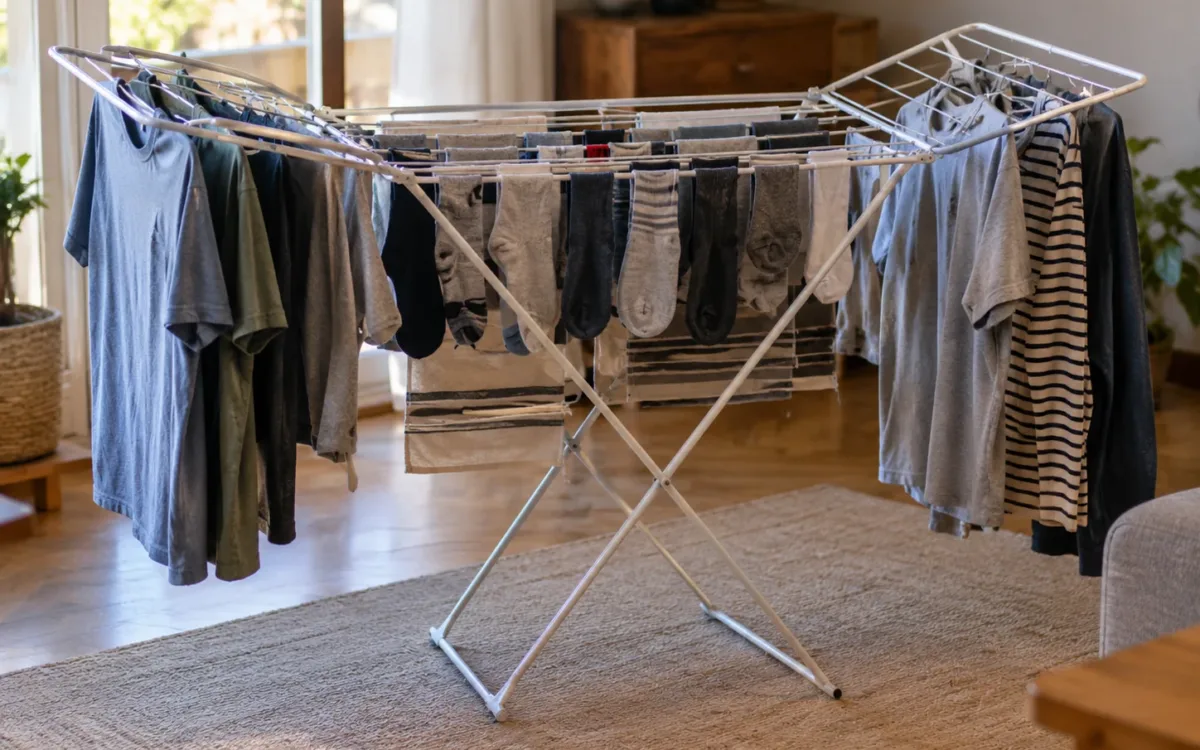
While many households simply place wet clothes wherever there happens to be enough space on the drying rack, Japanese laundry advice often recommends a much more organised approach, with longer garments hanging around the outside and smaller items, including socks and underwear, positioned towards the middle.
This particular arrangement is commonly known as the arch-drying method, a technique designed to encourage air to move more freely between wet garments, helping moisture evaporate rather than remaining trapped between layers of fabric.
The idea is surprisingly straightforward, because placing trousers, long shirts and large towels along the outer edges of a drying rack while gradually moving shorter items towards the centre creates an arch-shaped opening beneath the clothes, allowing air to circulate through the middle of the arrangement.
Although the method might initially appear to be nothing more than an unusually tidy way of organising laundry, the Japanese retailer MUJI has explained that the arrangement can improve airflow around wet fabrics, which is particularly useful when clothes are being dried indoors or in areas where natural ventilation is limited.
The technique is especially suited to the rectangular laundry hangers commonly used in Japan, which feature multiple clips for attaching individual garments, although the same basic principle can also be applied to conventional drying racks found in homes around the world.
One of the most interesting aspects of the method is that it has actually been tested, with Japanese household products manufacturer LION conducting an experiment comparing different ways of hanging laundry and discovering that the arch-shaped arrangement reduced drying time by approximately 30 minutes compared with a layout in which long and short garments were mixed together.
The findings, which were presented in Japan in 2013, suggest that the position of wet clothing can influence how efficiently moisture escapes, although the results should not be interpreted as proof that the same arrangement will always be the fastest option under every possible condition.
In fact, another experiment conducted by Japanese textile testing organisation Nissenken found that a V-shaped arrangement performed better in its particular test, demonstrating that factors such as fabric thickness, garment size, airflow and surrounding humidity can all influence which drying method produces the quickest results.
Nevertheless, the underlying principle remains useful for anyone who regularly struggles with laundry taking too long to dry, particularly during colder months when hanging clothes outdoors is not always practical and indoor drying racks can remain full for much of the day.
When wet garments are placed too closely together, the air surrounding the fabric can become increasingly humid, slowing evaporation and making it more difficult for the remaining moisture to escape, which explains why simply squeezing additional clothes onto an already crowded rack can significantly increase drying time.
The same problem occurs when large towels are folded over narrow bars or several layers of fabric are pressed together, because the overlapping sections receive less airflow and can remain damp long after the exposed parts have started to dry.
Instead, household experts recommend spreading larger items as widely as possible, leaving gaps between garments and avoiding arrangements that cause wet materials to touch one another, particularly when drying heavy fabrics such as jeans, bath towels and bedding.
Another important consideration is the amount of water left in clothing after the washing machine finishes its cycle, because even a load that feels reasonably dry to the touch can still contain a substantial quantity of moisture that must eventually evaporate into the surrounding air.
Using an appropriate spin cycle can remove more of this water before the clothes are placed on the rack, although delicate fabrics may require lower speeds to prevent stretching, damage or excessive creasing.
Where the drying rack is positioned can also have a major influence on the result, especially in homes where laundry is routinely dried in bedrooms, living rooms or other enclosed spaces without sufficient ventilation.
Placing a rack directly against a cold wall or hiding it in a tightly enclosed corner may seem convenient, but doing so can restrict airflow and allow moisture to accumulate, potentially creating unpleasant smells or contributing to damp conditions.
A room with adequate ventilation is generally a better choice, while a gently circulating fan can help move humid air away from the fabric, provided the moisture is also able to escape from the home rather than simply spreading throughout the building.
Drying clothes outdoors remains a practical option whenever weather conditions allow, although the Japanese arch method may be particularly appealing to people who rely on indoor drying during autumn and winter.
It is also worth remembering that claims suggesting this arrangement can cut drying time in half have not been convincingly demonstrated for the arch method itself, and the actual improvement will depend heavily on the amount of laundry, the surrounding temperature and the level of humidity.
For anyone interested in trying the technique, the process requires no special equipment or expensive household products, because the only real adjustment involves hanging the longest garments around the edges, placing shorter items towards the centre and ensuring there is enough space for air to move between everything.
That means trousers and large towels should generally occupy the outer positions, followed by shirts and smaller clothing items, while socks and underwear can be placed in the middle to create the distinctive curved opening underneath.
Although it might seem like an insignificant change to an ordinary household routine, the Japanese drying technique demonstrates how a little attention to the arrangement of everyday objects can sometimes produce practical benefits without requiring additional electricity or expensive appliances.
And the next time a load of washing seems to be taking forever to dry, moving those socks into the middle of the rack could be a simple experiment worth trying, especially when combined with good ventilation, adequate spacing and an appropriate washing machine spin cycle.